


A few days ago, while I was running, I listened to a 2021 episode of This American Life featuring two producers who described remarkably different internal experiences of moving through the world.1 I can’t remember what steered me to it, but it turned out to be a vivid illustration of the framework behind my approach to mindfulness.
I’m fascinated by what close attention can reveal about how our minds work—and by leaving room for the possibility that other people’s subjective experience may be very different from my own. So much of what we say about the mind focuses on the content of our thoughts. This conversation stayed closer to the underlying processes that make that content possible.
The mindfulness framework I learned from Shinzen Young gives me a way to decode this puzzle that feels simultaneously practical, consequential, and mind-blowing.2
At the grocery store, Lilly Sullivan’s attention leaps from a red shopping basket to questions about having a family, memories of her mother’s Volvo, something she did as a child, and guesses about what nearby strangers might be thinking and feeling. One perception triggers another thought, memory, question, or emotional reaction. She’s describing my default subjective state.
Her colleague Diane Wu describes something very different. She notices the red baskets. She examines the spinach mix. She takes in what is physically in front of her without automatically following it into an extended chain of associations. I’m married to someone who navigates the world more like this.
Lilly compares her mental activity to a washing machine, with thoughts tumbling around together. Diane compares her experience to a video camera pointing toward things in the world. Images register, but most of them don’t linger or become tangled up in interpretation.
Their conversation offers a vivid illustration of the difference between making sense and sensing directly.
We can loosely organize our moment-to-moment experience into three sensory categories:
visual
auditory
body sensations
Making sense draws on memory, imagination, language, prediction, and emotion. Sensing directly puts us in closer contact with the immediate flow of sights, sounds, and sensations.
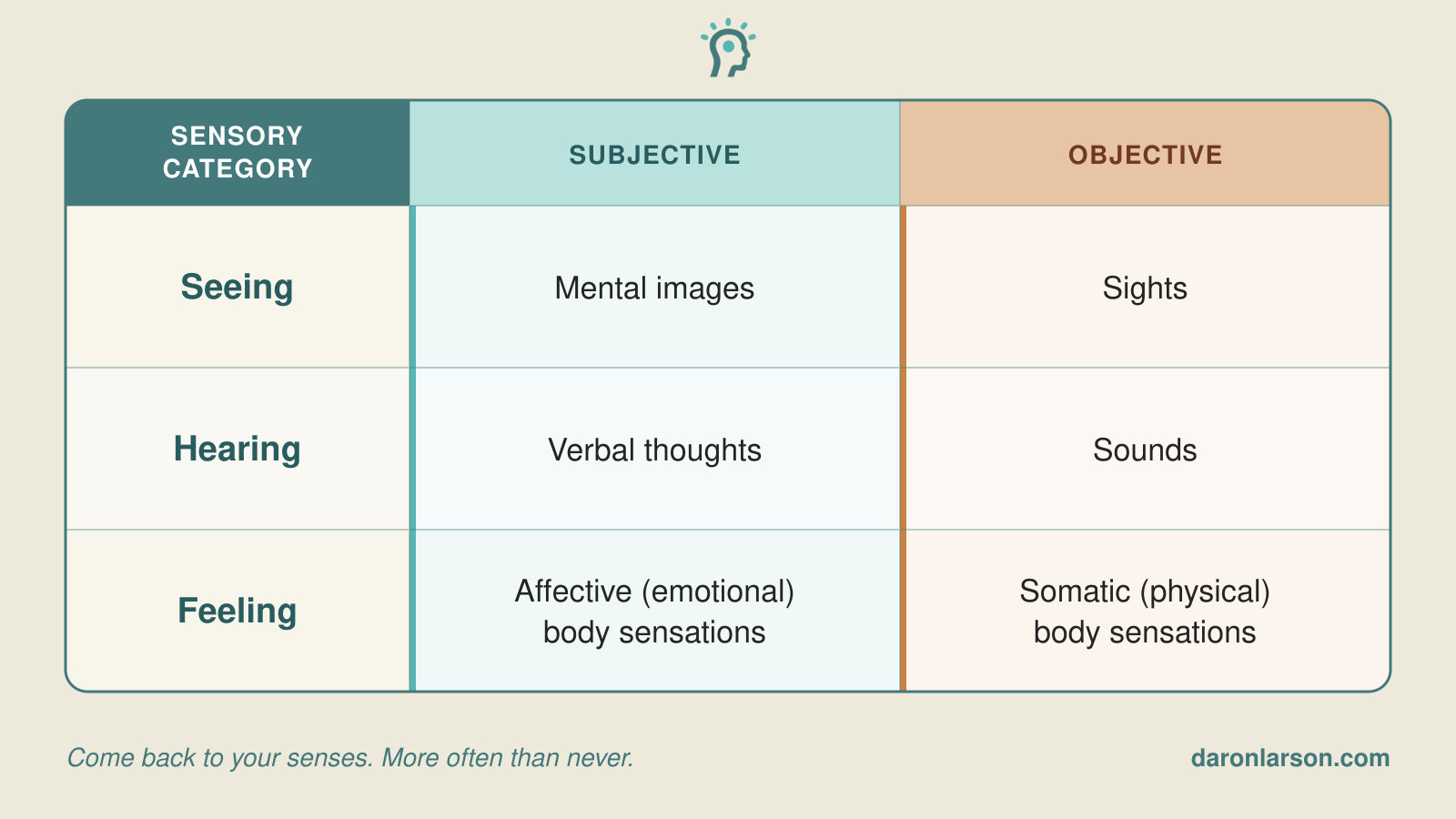
Neither mode is inherently better. We need mental processing to plan, solve problems, understand other people, and learn from experience. But mental processing can become so dominant that what our minds make of the world crowds out what is arriving through our senses.
Near the end of the story, Lilly reaches for an analogy I often use in describing multisensory mindfulness practice. Discovering how Diane’s mind works, she says, was like learning that some people live in the ocean while she lives on land.
I think of mindfulness practice as attentional cross-training that helps us become more amphibious—able to live on land, immersed in the content of our thoughts and feelings, and in the water, immersed in the immediate flow of sensory experience. We aren’t trying to relocate permanently. We’re developing the ability to move between the two more readily. Practicing before life becomes especially difficult can make confusion and uncertainty feel a little less impossible to inhabit when the resolution we crave remains out of reach.
Diane’s example focuses primarily on seeing. In the exercise below, we’ll work on getting our sea legs by listening instead. When the washing machine of mental activity is churning, you don’t have to force it to stop. See whether you can let nearby and distant sounds occupy more of the attentional field.
The point isn’t to escape thought. It’s to remember that thought is only one place your attention can live, and to leave enough room for more of the world to come in.
Exercise
This spatial listening exercise invites you to notice not what sounds mean or what caused them, but where they seem to occur—left or right, nearby or far away, all around, or close in. Try it while walking, waiting, completing a familiar task, or whenever mental processing has become the dominant feature of your experience.
Circumstances for learning this attention exercise
Choose a place where sounds are likely to arrive from several directions.
Sit somewhere where you can safely soften your gaze for several minutes.
Listen without noise-canceling headphones so the soundscape remains available.
