



This is the fourth installment of Find Rest in the Unrest, a ten-part series exploring how to notice and savor restful sensations amid ordinary life. Explore the series.
Silence doesn’t guarantee a quiet mind. Most of the time, it just gives you more opportunities to hear how relentlessly your mind talks.
I feel very fortunate to have discovered Shinzen Young about a year into my two-year experiment to see if daily meditation had any impact. Twenty-four years and retreats later, I still find the days away to be more like boot camps than spa retreats.
During his retreats, we had some extracurricular options, like continuing to meditate together through one night.1 Diving into them led to some fascinating observations that changed how I practiced when I returned home. In particular, I repeatedly observed my verbal thoughts becoming less coherent. Familiar arguments and judgments dissolved into word fragments, nonsense syllables, and sounds.
Instead of a clear, convincing mental voice telling me, “Who do you think you are? You’re wasting your time with all of this nonsense,” the same commentary began to sound more like “Bloobity, blahbity, blah.”
As sentences began to sputter out halfway through, I felt wonder and relief instead of distress. I remember thinking, “Is staying up a couple of hours later than usual all it takes to make my thoughts sound less convincing?” I bristled, wondering how many disastrous personal decisions I’d made after midnight.
What had seemed like a persuasive internal monologue a few hours earlier could suddenly shift from a cello solo to percussion riffs. Hearing my verbal thoughts as sounds, rather than getting instantly caught up in their meaning, helped loosen their grip on me.
When you start listening to verbal thoughts this way, something else becomes easier to notice: the moments when your inner voice isn’t saying anything. Sometimes there’s a pause between sentences. Sometimes a thought trails off without finishing. Sometimes you can sense mental activity continuing, but no recognizable words appear.
You might hear a car passing outside, notice a sensation in your body, or simply register that no internal commentary is apparent. The quiet doesn’t necessarily feel dramatic or profound. It can be surprisingly ordinary—and easy to miss when you’re preoccupied with what your thoughts are saying.
I’m not suggesting that you need to stay up all night, go on a silent retreat, or experience your thoughts turning into gibberish to learn to make this distinction. But you do need opportunities to practice, along with a willingness to occasionally deprioritize what your thoughts mean.
Extended practice can make it easier to recognize how much energy we spend fighting our own thoughts and feelings. The goal isn’t to replace an ordinary life with a monastic one. It’s to turn ordinary life into a laboratory for investigating our own subjective experience.
All that extra practice time just increases the odds of spontaneously dropping the internal fight. Sometimes we simply stop struggling without realizing we've stopped. Other times, the thoughts become less compelling for a few moments. You hear them without identifying with them.
That’s an experience we can recognize and become more familiar with in everyday life. A few minutes of consistent practice can help us explore what happens when we listen to our thoughts instead of automatically following them.
It’s one thing to understand intellectually that we don’t have to believe or obey every thought. It’s another to become familiar with what thinking actually feels and sounds like—and gradually develop the ability to respond differently.
In our earlier exploration of listening to sounds, we practiced noticing when a sound ended and listening to the relative quiet that followed. We weren’t trying to make the world silent. We were learning to recognize quiet that was already available.
We can apply that same skill to verbal thinking. Instead of trying to make our minds stop talking, we can learn to hear words, phrases, and sentences as they arise and disappear. And when no words are apparent, we can listen to that, too.
The circumstances are different, but the attentional skill is remarkably similar: recognizing both activity and rest without having to manufacture either one. We practice detecting what is happening rather than demanding that something else happen instead.
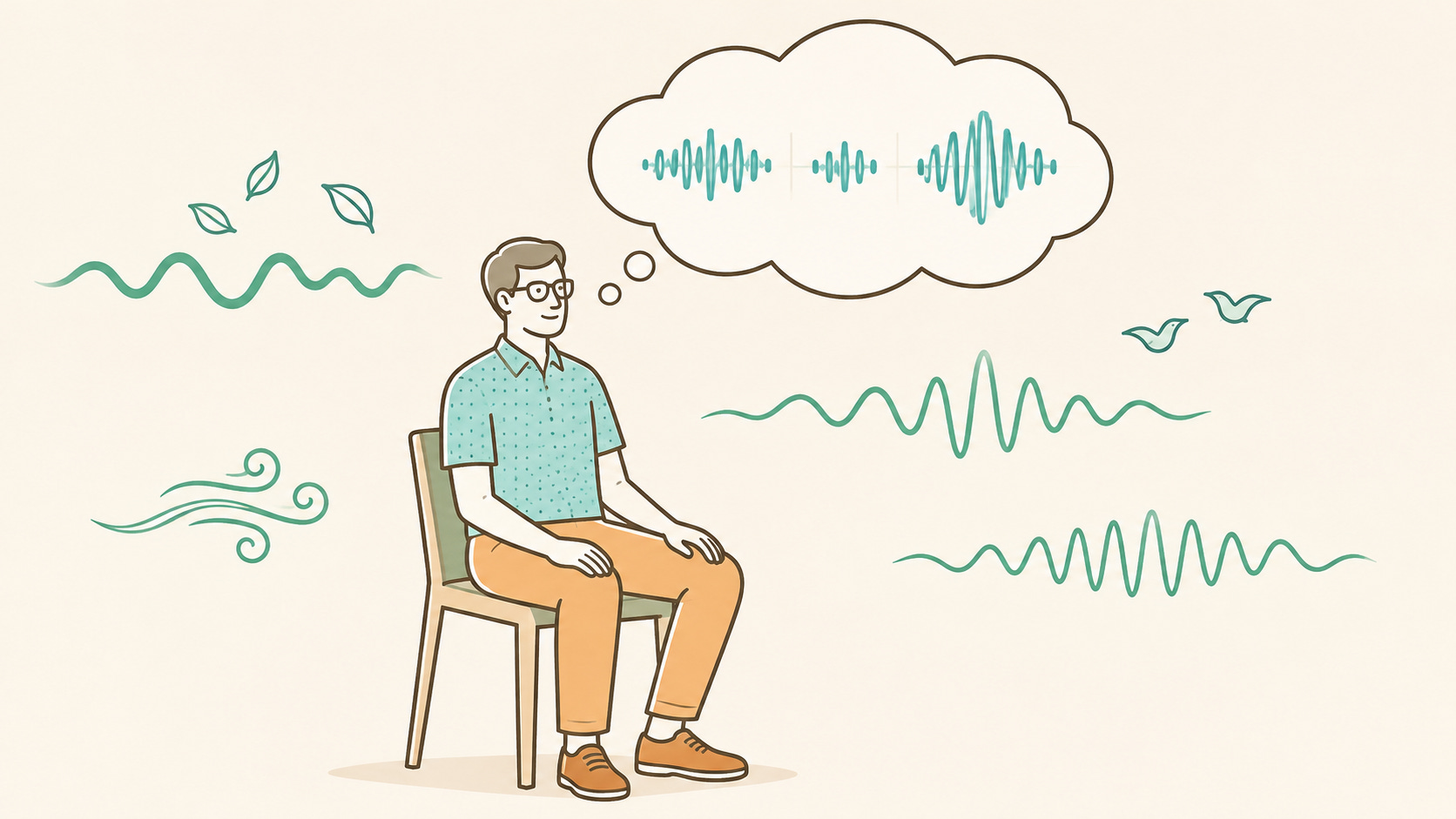
Learning to hear thoughts as sounds and recognize the quiet between them develops two related abilities. We become better at noticing when thinking is happening, and better at recognizing that we don’t have to entertain every thought as a rigid inevitability. We can leave room for some thoughts to be useful and wise while others are more like noise.
Imagine getting a text message that immediately triggers an indignant internal response. Before you’ve even decided what to say, you’re rehearsing an argument, anticipating objections, and composing your defense.
Notice what’s happening. Your mind may be generating images of what happened or what might happen next, rehearsing arguments, and producing emotional sensations in your body. All of these experiences can feel compelling, especially when they seem to confirm a familiar interpretation of events.
Recognizing this activity as something you’re experiencing—not simply the truth of the situation—creates a little more room to decide where to put your attention and what to do next.
You might still decide to speak up, make your case, or take action. The difference is that you're less likely to mistake the first words that appear in your mind for instructions you must follow. These skills can help us savor pleasant moments more, decrease internal friction when situations feel heated, and respond rather than react on autopilot when stakes are high.
We often imagine that responding thoughtfully is primarily an intellectual achievement. But it also has a physical, practiced dimension. Like learning to play a musical instrument, we develop skills through repetition that can become available when we need them—not because we suddenly remember an important idea, but because we’ve practiced putting it into action.
Listening to sounds can teach us how to hear silence. And learning to hear silence can prepare us to recognize the quiet between our thoughts.
Not because we've finally managed to stop thinking, but because we've learned to listen differently. It's a skill that becomes more accessible—and empowering—the more we practice.
Exercise
This attention exercise explores how to recognize brief moments of mental quiet by listening to your inner voice, slowing down verbal thoughts, and noticing the pauses between them.
Circumstances for learning this attention exercise
Waiting for something to begin
Walking or doing a familiar task
Noticing that you’ve become caught up in your thoughts
