


During last Saturday morning’s online mindfulness practice group, Tony, a regular participant, shared something he’d been noticing that everyone instantly related to.1
The choices he most often regrets are usually the quickest and easiest ones to make.
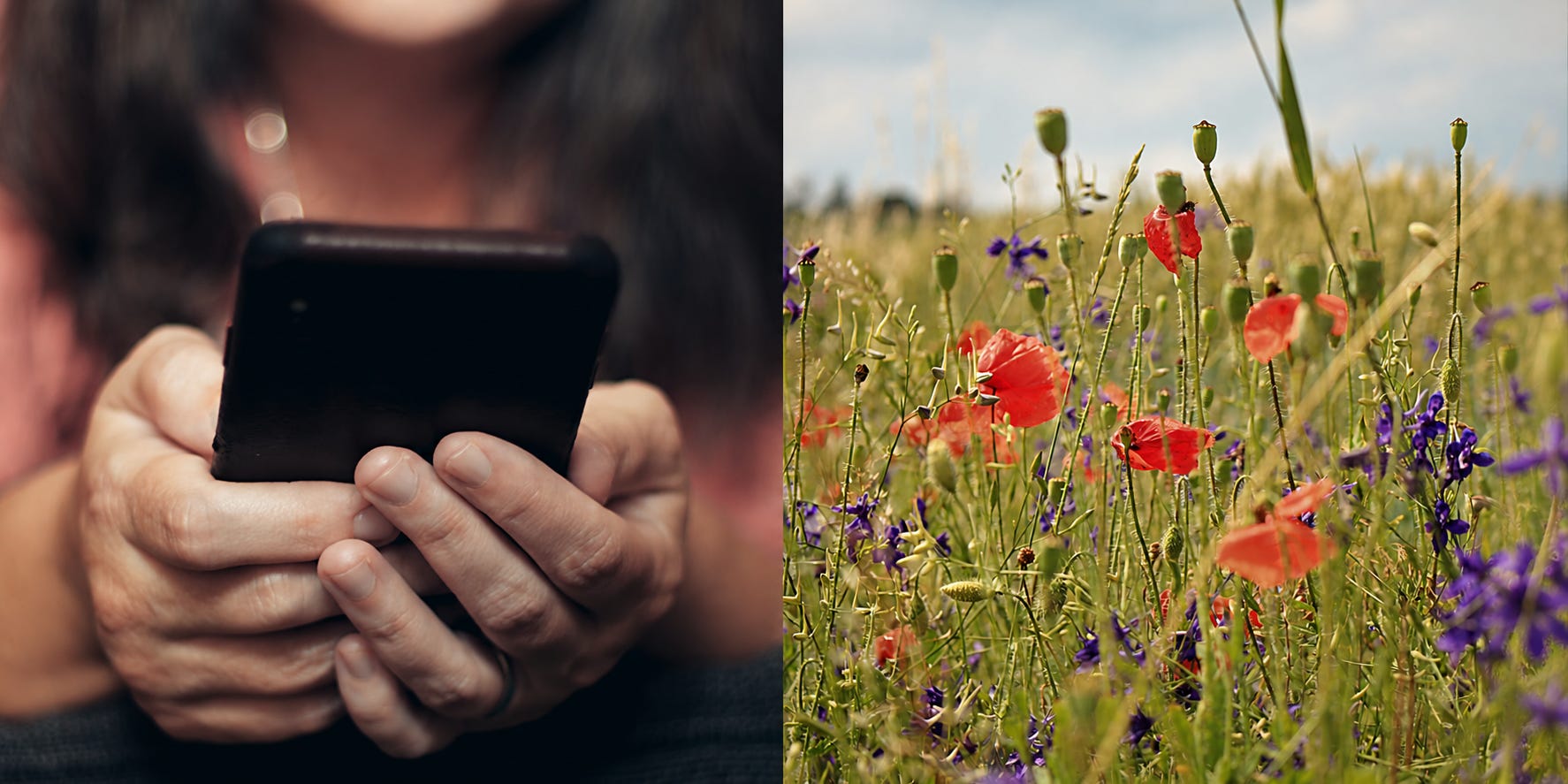
One day last week, he felt the urge to pick up his phone and start scrolling through news and social media. He had already started the process when he stopped and asked himself: Is this really what I want to be doing?
He could already feel the undertow. It would be so easy to burn through some time scrolling. And he knew there was probably something he actually needed or was looking for—a vague sense of relief, rest, or a break.
Then he remembered a field of wildflowers he had recently discovered in a park near the YMCA, about a 10- or 15-minute drive from his house.
Do I really want to get in my car and drive somewhere?
His phone was right there.
But he decided to treat it as an experiment. He got up, drove to the park, and almost immediately felt glad that he had.
The payoff was nearly instantaneous: flowers, grass, clouds, the warmth of the sun, the breeze against his skin. And unlike the scrolling, the experience wasn’t tinged with regret afterward.
He had the striking realization: Oh. This is what I was looking for.
Scrolling wasn’t necessarily the thing he wanted. It was the frictionless substitute for the experience he actually needed.
As he shared these field notes from applying mindfulness in real life, I could see everyone leaning in. We all immediately appreciated the unfairness of the fight.
Scrolling required essentially nothing. Going to the wildflower field required making a decision, getting up, getting into the car, and driving there.
Everyone already knows how quickly we can yield to the frictionless choice—even when we know the slightly harder choice is likely to be more satisfying.
The bad news
I think the bad news is that making the harder choice—the one with some friction built in—may never get easy.
Maybe the mistake is assuming that it should.
We imagine that if mindfulness really worked, or if we’d developed healthier habits, eventually we’d naturally want to make the better choice. The impulse to scroll would go away. We’d opt for steamed broccoli instead of French fries. We’d go to bed at a time we wouldn’t regret in the morning. We’d effortlessly act in ways that are consistent with our values.
But what if ease doesn’t belong in the equation?
Maybe scrolling continues to be easier because it is easier. The phone is already in our hands. The wildflowers are ten minutes away.
Mindfulness doesn’t make harder choices easier.2
The good news
Even if making the choice feels as difficult as it did the last time, we’re not actually starting from scratch.
Every time we make that internal adjustment—every time the easier choice doesn’t automatically win—we’re practicing willingness.
And I think that’s a useful way to understand mindfulness when it goes beyond breath awareness or relaxation. We’re training our willingness to be with what’s actually happening—our willingness to experience some discomfort without immediately trying to escape it, and to experiment with doing the less convenient thing sometimes and seeing what happens.
The friction may remain.
But we can become more willing to navigate it.
Something else gets trained
There’s another part of this that’s harder to talk about because understanding it conceptually isn’t enough. It has to be experienced.
When we practice being more willing, we’re also training our capacity to experience what waits on the other side more deeply.
Tony wasn’t starting from scratch when he arrived at the wildflowers, either.
The sunlight, flowers, grass, warmth, and breeze were sensory experiences he had become practiced at noticing. The more often we collect sensory data—the taste of what we’re drinking, the feeling of a mug in our hands, the breeze against our skin, the complexity of the sounds around us—the more familiar we become with inhabiting those experiences.
It’s a kind of sensory connoisseurship.
Someone who has trained their palate for food, their nose for wine, or their ears for jazz isn’t necessarily encountering a different wine or piece of music than the rest of us. Their capacity to perceive what’s there has become more refined.
Our sensory lives can become richer in the same way.
So while the willingness to choose the wildflowers may never become effortless, what happens when we get there doesn’t remain at a beginner level.
We become better at receiving the payoff.
An attentional fitness test
Several years ago, I wrote about a quick and free way to assess your attentional fitness.
My suggestion then was simple: find something that pushes your buttons and pause long enough to feel your emotional reactions in real time.
I wrote that investigating sensations when you’re uncomfortable doesn’t magically make them comfortable. But it can help you recognize them sooner, fight with them less, and avoid making painful matters worse.
I still think that’s true.
But I’d broaden the test now.
The next time you notice a frictionless but probably regrettable option presenting itself, don’t suppress it. Don’t feel bad about wanting it. And don’t get tangled up in what you should do instead.
Just notice it.
Then ask: What’s one slightly less convenient alternative?
Maybe it’s getting off the couch. Going outside. Making the phone call. Staying with an unresolved feeling for another minute. Tasting what you’re eating instead of watching something while you eat it. Driving ten minutes to see some wildflowers.
Notice the friction, and if you’re willing, cross it and see what happens.
The point isn’t to always make the harder choice. Harder isn’t inherently better, and sometimes rest and ease are exactly what we need.
The practice is becoming a little more capable of noticing when ease is offering us what we actually need—and when it’s offering us a frictionless substitute. And forgoing short-term comfort now and then is the price we pay to feel more alive.
The harder choice may not get easier.
But we can get better at making it.
And better at experiencing what waits on the other side.
Training your attention doesn’t solve your problems. It builds capacity for responding to whatever life brings.
Thank you Daron. I can sometimes feel in my body the allure of the frictionless choice. My whole nervous system roots for that choice!
Yes! This is why I'm so glad that we're still a group together. We have so much to learn from each other, and have the opportunities to do so.