


This is the third installment of a four-part series on noticing impermanence in real time.
In July 2021, Bob Odenkirk’s heart stopped for 18 seconds while filming Better Call Saul. He talked about it on the Wild Card podcast recently, saying it didn’t actually feel emotionally traumatic.
As he slowly woke up over the next week, he felt a lingering sense of joy and appreciation for life. The world seemed “pretty magical and beautiful and astounding. A marvel to look at and be in.” When that feeling started to fade, he told himself:
“I have to remember this. I have to try to live this way. I have to try to be this, see the world this way.
This ends.”
I’ve been lucky to have moments like the one he described, though nothing as dramatic as surviving a heart attack. Silent meditation retreats can help you face your own mortality and deepen your appreciation for the simple wonder of being alive. These memories tend to stick with you.
I remember being three days into a retreat in California when the internal friction and noise of daily life started to quiet, letting something new in. The orange trees looked more alive, and I could really feel the breeze on my skin. The colors and textures of the sky, clouds, and ocean all seemed richer and more vibrant than before. My thoughts and worries felt lighter and less consequential.
Something had flipped. My perspective shifted, and I saw, heard, and felt everything differently than just a few minutes earlier. It wasn’t like looking through a magical filter. In fact, it felt like the opposite of special. Natural. The shift instantly affected all my senses and perceptions, as well as the rich complexity of their combined parts. I’d experienced this inverted perspective before through similar contemplative efforts, so it felt both foreign and familiar. Relief that comes from setting down something heavy you’ve grown used to carrying, or coming up for air after being underwater for too long. Completely ordinary, yet lighter and more alive. Surprised by embodied joy rather than imagined joy.
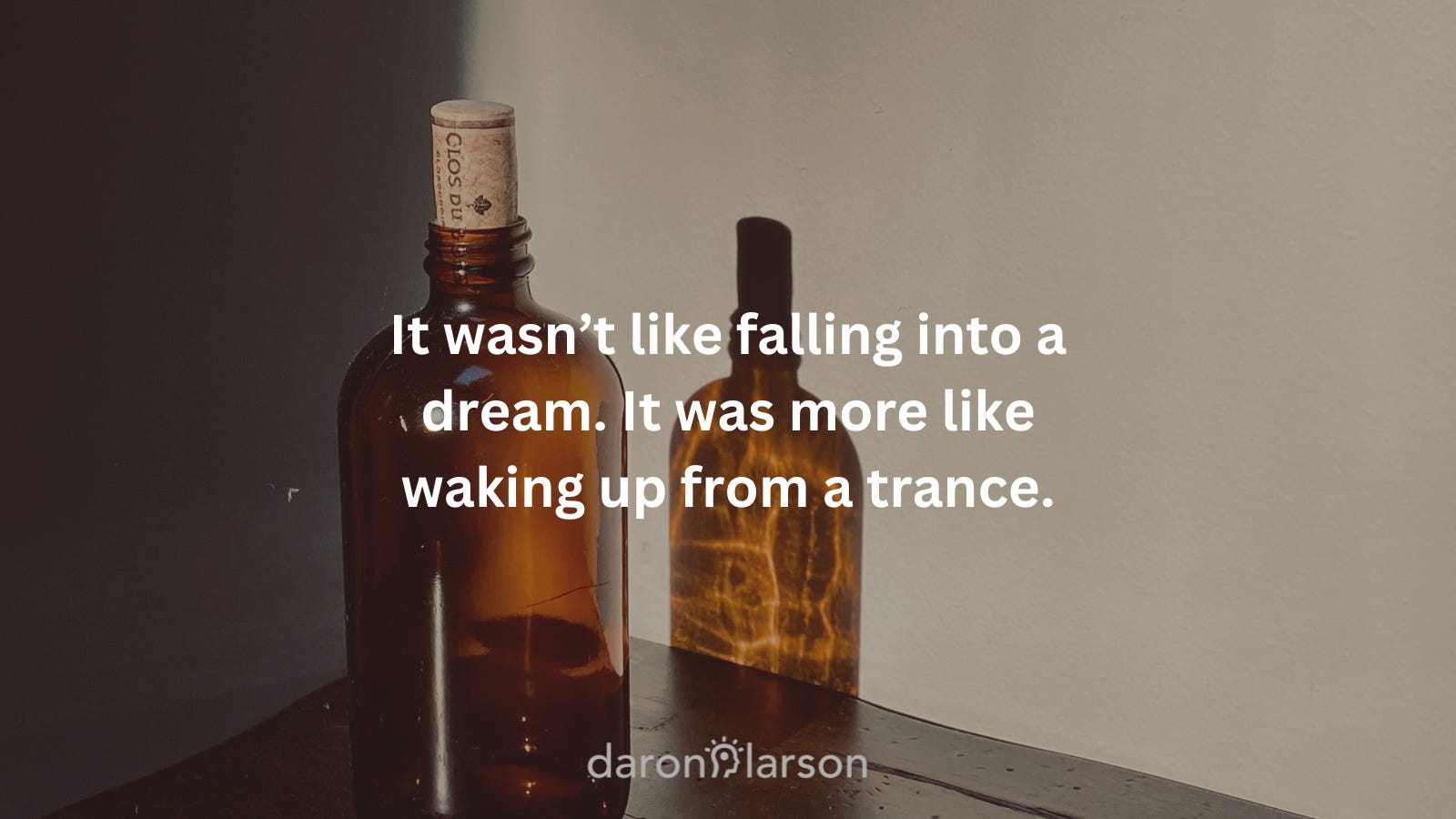
It wasn’t like falling into a dream. It was more like waking up from a trance.
Meditation wasn’t adding something new that I’d been missing. Instead, it slowly took away something I hadn’t noticed until it fell away. Day-to-day life had actually been the altered state. Becoming more aware of ordinary sights, sounds, and sensations felt like returning to normal — an unaltered state. Realizing this made me want to send a message in a bottle to my future self, the one who would likely fall back under the old spell again.
When I got home, I searched for the perfect bottle, and eventually found an amber one with a cork. But even after all these years, I still haven’t figured out what to write on the note to put inside it. Maybe what I need the everyday me to remember can’t really be put into words. So the bottle sits empty in my room, reminding me of something I once understood more viscerally than I can fully explain to myself now.
What strikes me now is how this lesson keeps coming back in different disguises. On that retreat, it arrived through stillness and steady practice — something I have to carve out deliberately by stepping away from my ordinary routine. A couple of weeks ago, it arrived in the middle of a downpour.
I was out on a walk with my grandchildren — Frankie on his bike, Quinn walking alongside me, her attention perpetually pulled to pebbles, weeds, and cracks in the sidewalk — when the sky just opened up. Frankie started crying in that desperate, unglued way little kids can get when the world suddenly feels like it’s attacking you. A reaction many adults, understandably, never fully outgrow.” And yet the whole thing felt so alive to me in a remarkably pleasant and ordinary way. Frankie raced home ahead of us as I scooped up Quinn, and we walked through it laughing. I said: “It’s okay. It’s just water. It’s like taking a shower with your clothes on.” And, even though Frankie couldn’t hear my words and Quinnie is too little to comprehend them, we really were okay. Better than okay. Soaked, but a little more alive than we’d been when we’d left the house.
That’s the strange thing about these kinds of moments. They don’t require a near-death experience or a ten-day meditation retreat. Sometimes they arrive unexpectedly, drenching us, with a crying six-year-old, in the middle of an ordinary Tuesday afternoon. The quality of aliveness that Odenkirk is describing — that I spent three days paying closer attention in a simplified environment to touch — fell on us right there on the sidewalk by a garden-variety shift in the weather.
The body seems to know how to make this subtle yet significant shift into feeling less trapped by life and more alive in the messy midst of living. We just can’t force ourselves there on demand. But we can familiarize ourselves with it, little by little, over time. We can stop searching for exits and learn to spot quiet invitations to dive into the ordinary sensory details that are always on hand.
During a recent webinar about sneaking mindful awareness into daily life, someone asked what paying attention to ordinary sensations actually does — what it translates to in real life. My first answer was: a richer experience of being alive, especially in ordinary moments. The longer answer is that it also trains something. The ability to toggle back from the narrative running in your head to the raw, immediate living data of what’s happening right now. That capacity — practiced in small, unremarkable moments — is what shows up when it counts. At the extremes: crisis, grief, overwhelming joy. And also, sometimes, in the spring rain.
The visual field is a good place to practice this because it’s always moving and we almost never notice it. Branches sway. Light shifts. Trucks drive by. Whatever we’re looking at is also, if we let it, an ordinary-extraordinary phenomenon we start seeing through.
In today’s exercise, that’s what we’re exploring. Not staring hard to understand. Just seeing — and noticing what changes.
Exercise
This exercise helps you get better at noticing changes and movement in the sights around you. You can adjust this exercise to fit any situation. I encourage you to try it in different places—outside, looking out a window, on vacation, or when you return home.
Circumstances for learning this attention exercise
Sitting on a park bench
Taking a walk at magic hour
Sitting at the gate waiting for your flight to board
