




What comes to mind when you hear the term “mindfulness”?
Flexible vegetarians sitting cross-legged in silence, making okay signs with their hands while chanting “om”?
If so, I get it, but the Age of Aquarius waned a long time ago. The Age of Distraction is now in full bloom, and we need practical ways to cultivate attentional agency without adopting an ideology.
When I think about mindfulness, I imagine people learning to worry less while waiting for medical results, parents maintaining greater composure when their children misbehave, and individuals who want to be able to eat, use the restroom, and fall asleep without relying on a constant stream of cat videos.
I picture more people discovering that exercising their attention is similar to exercising their bodies. However, it’s less obvious how to practice it, since you can’t observe another person’s attention-training efforts. Practicing mindfulness also involves trading certainty for uncertainty, perfectionism for messy humanity, and stimulating stories for high-definition sensations, which can often be destabilizing—no wonder so many people get confused and give up.
The challenge reminds me of something my art teacher explained to me in college. We were trying to sketch a chair that she had placed in the center of the studio. She repeatedly reminded us to stop drawing the stereotype of a chair we were picturing in our minds.
She described a classic art exercise in which an image is inverted to practice drawing what we actually see, rather than relying on the mental picture we have formed. By narrowing our eyes to blur the visual field just enough to disengage from the chair, we could better perceive the collection of shapes that constituted the chair.1
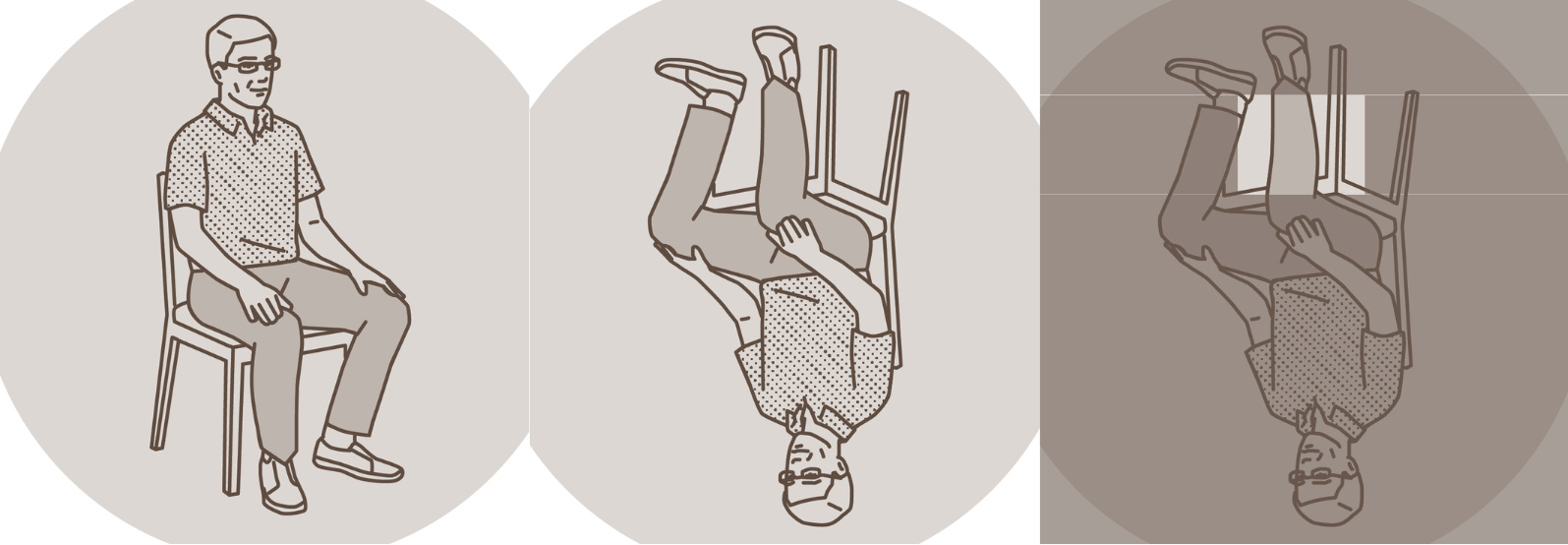
In designing the exercise below, I apply this insight to the observation of sensations without attempting to align them with our mental concepts. We can do this by considering them from a different categorical perspective: how pleasant or unpleasant the sensations feel in the moment.
Let’s use a system of hedonic categorization2 with four possibilities:
mostly pleasant
mostly unpleasant
a mixture (both)
neither (neutral)
As you notice a sensation in your body, assign it to one of these categories and then take a moment to really feel it.
It’s okay to guess
If you’re not sure which category best describes the sensations, make a guess. This is more effective than overthinking it. Stay unsure and feel what you feel. Instead of striving for perfection, practice guessing. The more you guess, the more accurate your guesses will become.
It’s impossible to get it wrong
Cultivating mindful awareness involves striving to become a bit more objective about your subjective experiences. While complete objectivity is impossible, you can aim for a little more objectivity when possible. This means that whatever you consider to be pleasant is pleasant enough for your purposes, and the same is true for what feels unpleasant. The next time you experience the same sensation, your assessment may change, and that’s perfectly okay.
It’s okay to skip
If you can’t decide which category to file a sensation under, it’s okay to move on to another one. This decision would be better than getting tangled up trying to get it right. There are plenty of sensations occurring in the body at any given moment, so it’s okay to take a pass on categorizing some of them.
It’s okay to revise your guess later
As you collect repetitions of noticing what you feel, you might land on an option that seems more accurate than your first interpretation. The more you practice this process, the quicker and more accurate your ability to categorize feelings will become.
We’re used to making sense of everything around us, judging ourselves, each other, and the world as either good or bad. This default form of analysis requires that we simplify whatever we’re judging. Sensory categorization provides an alternative analysis that counteracts the tendency to judge.
In almost every focus-building attention exercise, we develop three essential attentional skills. These are: the ability to choose what to attend to, the ability to make clear distinctions about what we focus on, and the ability to observe with minimal internal interference. Allowing yourself to make enthusiastic guesses when categorizing perceptions enhances all three of these skills.
By incorporating this practice into your daily habits, you will begin to reduce overall prediction error. This means that by being open to the possibility of being wrong, you will gradually learn to make more accurate predictions. You will notice this change when ordinary moments start to feel more vibrant and alive, even the uncomfortable ones.
Exercise
This exercise leverages the complex ambiguity of body sensations to practice feeling what you feel with less resistance.
Circumstances for learning this attention exercise
Sitting through a boring meeting
Shopping for gifts or groceries
Watching a movie someone else picked


