



Paying attention to the sensations of breathing is a reliable attentional exercise that I turn to often, but breath awareness isn’t synonymous with mindfulness and was never intended to be the whole game.
The appeal of a one-method approach is obvious. The instructions are basic enough that you can hear them once and begin practicing right away: simple, but not easy. Even so, the convenience doesn’t make it a complete or robust attentional system.
Yet a single exercise has come to stand in for an enormous category of attentional training, reducing it to simple breath awareness for relaxation and diluting its liberating potential.
My personal experience of this narrow framing began twenty-four years ago this month. At my first silent meditation retreat in October 2002, breath awareness was the only practice I was taught specifically to strengthen and stabilize attention. I also learned loving-kindness, but I had not yet encountered a broader repertoire of exercises for training attention in a more flexible, durable way. Over time, that broader repertoire is what made the practice sustainable and useful in countless practical ways, while strengthening the fundamental attentional capacities I could draw on in very different real-life circumstances.
Given how dramatically things can change from one moment to another, why should we expect the same exercise to make sense in every situation and work for everyone?
Let context guide your practice
If you are like me, some mornings you wake up with a little extra energy, and other days you feel like you are dragging, despite what your sleep-tracker score says. Sometimes you are grouchy for no reason, and sometimes a cup of coffee is enough to perk you up for a project you are eager to work on.
Maybe you’re excited about an upcoming presentation. Or maybe the anticipation terrifies you, and you regret ever raising your hand. Maybe you spend the time you could use to prepare devising ways to keep your future self from agreeing to another panic-inducing situation you can’t overthink your way out of.
Maybe you feel angry, heartbroken, or powerless because of something you read online while waiting for the coffee to brew.
Sometimes we’re hungry. Sometimes we regret overeating. Sometimes we watch ourselves barreling past the line between the two.
Maybe you feel deep appreciation for the life you’re living right now, and for the people you’re living it with. Or maybe conjuring up things you should feel grateful for feels like a cruel homework assignment, even though people you respect swear it improves their mental health.
Sometimes we collapse into bed, exhausted in a good way after exercising or working hard, and fall asleep effortlessly. Sometimes we get up to pee at two in the morning and end up staring at the wall, wide awake, yearning for unconsciousness.
Why should we expect all of these situations to call for the same attentional exercise? The breath is obviously available, but it’s not the only option, and we may be leaving useful options unexplored.
What if mindfulness weren’t just something we apply when circumstances become overwhelming, but also a powerful way to prepare for them before they do?
Know your options before you need them
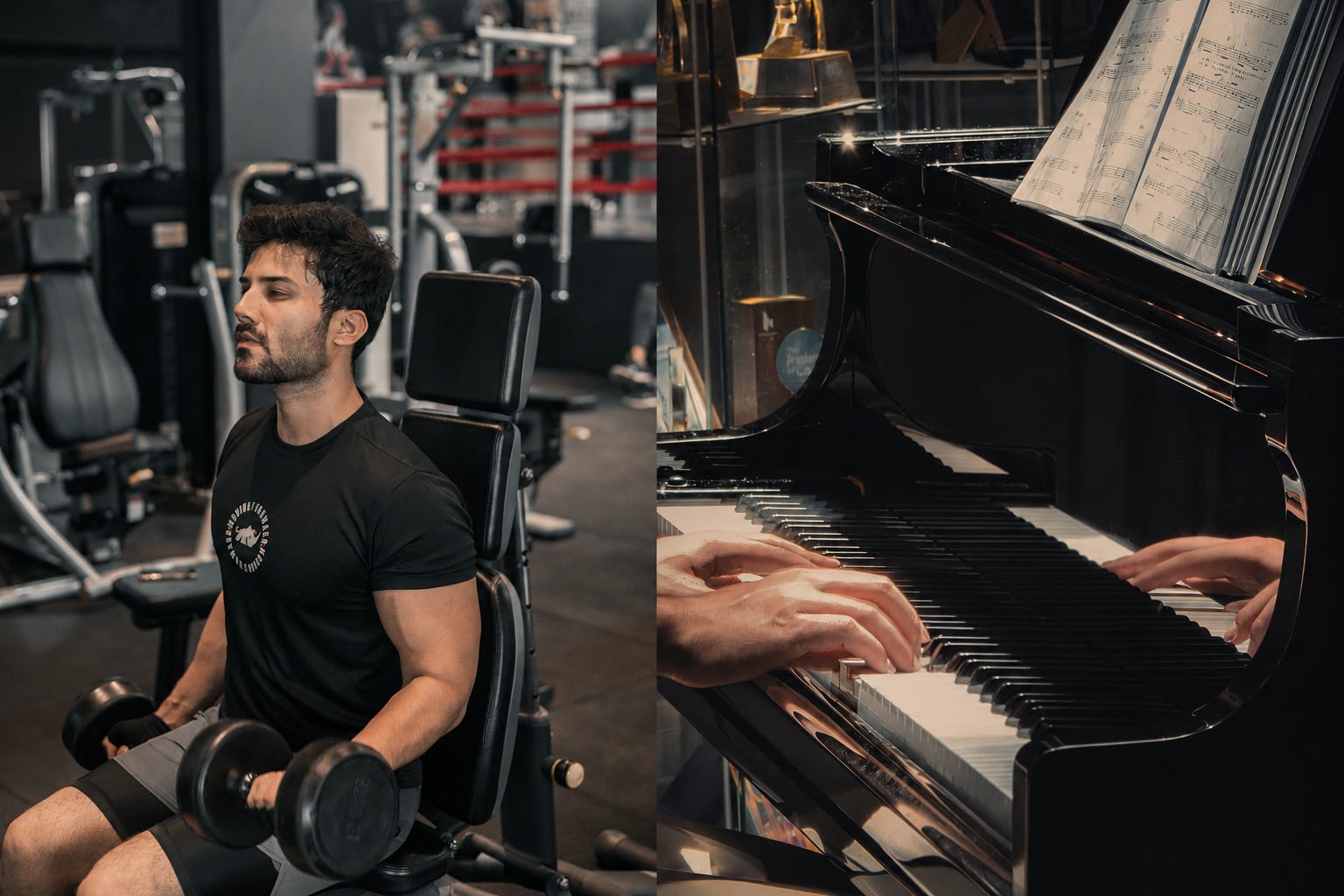
Whether or not you exercise regularly, you probably understand that physical fitness offers a range of options. You might run, swim, ballroom dance, or just try to nudge up your daily step count. Even after you decide to exercise regularly, you still have to decide what kind of exercise makes sense today.
How much energy do I have?
Am I sore or recovering from something?
What did I do yesterday?
Am I training strength, endurance, or mobility?
How much time do I have?
Learning to play a musical instrument is like that, too. When I returned to the piano after stepping away from it for many years, I realized how much theory and technique I had missed or forgotten. My current teacher recommended that I work through a ten-volume series on piano theory, starting with volume five, since I’m already familiar with most of what comes before it.1 While I’m not starting from scratch, it still blows my mind how much I have to learn. So much goes into breaking the puzzle of a Chopin waltz into a series of choices and movements—when to lift the sustaining pedal, how to slur a legato passage, and when to lift my wrist, like sneaking in a quick inhale before diving into the next phrase.
We’d never expect a piano teacher to explain why someone should practice piano in a 45-minute talk while somehow squeezing ten volumes of theory into it. Yet we often treat mindfulness as so simple that a brief webinar at work can substitute for a skill-based curriculum.
The complexity of mindfulness doesn’t mean individual exercises have to be complicated. They can be remarkably simple. The challenge lies in building a repertoire, learning what each exercise develops, and becoming familiar enough with the options to choose among them consciously.
One push-up is doable. So is a C major scale, once the fingering becomes muscle memory.
Noticing the sensations of breathing can be simple enough to explain in one sentence and rich enough to practice for a lifetime. That doesn’t mean it is your only—or best—option for making a practical impact on different areas of your life.
So what are your options?
Whether you’re practicing mindfulness in formal meditation, sneaking it into everyday activities, or using it to navigate a challenge, your options fall into three broad categories.
You can practice with what you’re sensing. Sights, sounds, bodily sensations, smells, and tastes give us continuous information about our experience. Whatever your circumstances, these ordinary sensory phenomena shape your experience. Learning to make finer sensory distinctions gives us more to work with, so more moments feel as if they are being lived in high definition.

You can become curious about what is happening inside you. Thoughts and emotions constantly weave stories with you as the main character, but you can learn to distinguish some of their parts—mental images, inner speech, and emotionally charged sensations in the body—the way a film editor observes composition, lighting, and sound for their emotional impact.

You can savor comfortable sensory details or try to observe uncomfortable ones more objectively. You can ease up on the impulse to hold onto what is pleasant, resolve uncertainty, or explain an unpleasant emotional reaction. You can focus on one detail or quality at a time, or let your attention move through the complex stew of the moment you are inhabiting.

The point isn’t to cram every option into every practice session. It’s to become familiar enough with them that choosing what to practice becomes part of the practice itself.
Exercising your options
The sensations of breathing are always available, but so are sights, sounds, other bodily sensations, and all the related mental and emotional processing happening beneath the surface.
Contextual mindfulness means knowing your options well enough in advance to make conscious choices among them based on the circumstances.
Let’s say you notice that you’re feeling anxious. The source of the discomfort doesn’t matter.
There are several options you could explore:
Focus on sights and sounds around you.
Investigate the anxiety-flavored sensations in your body.
Explore parts of your body that aren’t conveying distress.
None is inherently the correct choice. Each offers different information to observe.
Regardless of the option you choose:
The anxiety might intensify.
It might diminish.
It might stay exactly where it is.
Something else might become more noticeable.
You’re not desperately searching for a resolution to every feeling of real or imagined danger. You’re practicing observing emotional sensations with less internal interference—not rushing to eliminate them, but becoming curious about what you feel as you feel it.
Someone might report feeling sad and exploring the contours of the sadness in their body.
Excellent choice!
They might notice that after observing it for a few seconds, it grows stronger.
Excellent observation!
Another person might attend to parts of the body that aren’t conveying anxiety, feel their shoulders and face soften, and discover that the anxiety has dissipated.
Also an excellent choice!
Formal practice teaches you options. Daily life gives you opportunities to experiment with them. What happens in daily life teaches you things that change how you practice.
And so it goes, back and forth.
We can learn to shift attention from an emotionally charged story to the components involved in experiencing it: mental images, internal dialogue, and emotionally tinged sensations in the body. Feeling like a character in a story doesn’t go away, but becoming better at tracking what’s happening internally creates options when the plot takes an unexpected turn.
This is how contextual mindfulness develops attentional agency.
Train for the circus
If you feel peaceful and relaxed, great—enjoy it. When you feel rattled, you don’t need to resolve your agitation before returning to mindfulness. The agitation can become part of the practice. The mistake isn’t wanting discomfort to go away. It’s treating relaxation as evidence that you’re doing mindfulness correctly.
Practicing mindfulness is more like walking a tightrope than sitting in a hot tub with cucumbers on your eyes.
Walking the high wire requires tuning in to your body’s signals and adapting as conditions change. We can’t rely on perfect weather. We have to accommodate breezes and gusts. Internal balance isn’t a fixed state. It has to be supple to be livable. Finding it requires small, continuous adjustments. If we’re too rigid, we can’t respond. If we’re too relaxed, we collapse.
Feeling alive can be exhilarating and terrifying. We can be delighted by witnessing a simple act of kindness. We can feel heartbroken by cruelty. We can laugh, be turned on, or feel embarrassed. Sometimes several of these things are happening at once.
We can use ordinary moments as a training ground for becoming more intimately familiar with what it feels like to be alive, regardless of the circumstances.
Ashleigh, M., & Snell, K. (1998). Fundamentals of piano theory, Level 5. Neil A. Kjos Music Company.