



Mindfulness meditation has a lot in common with practicing the piano.
Both require explicit instruction, consistent effort, and a willingness to fall in love with the process rather than obsess over the results. They are also both about finding tangible ways to navigate the abstract murkiness of time.
Learning a new piece of music involves slowing down and counting out the rhythm represented by the notations on the page. Sometimes I have to work on decoding each hand’s part independently before I can start playing them together. This is the only way I can learn Bach’s mind-blowing little two-part inventions.
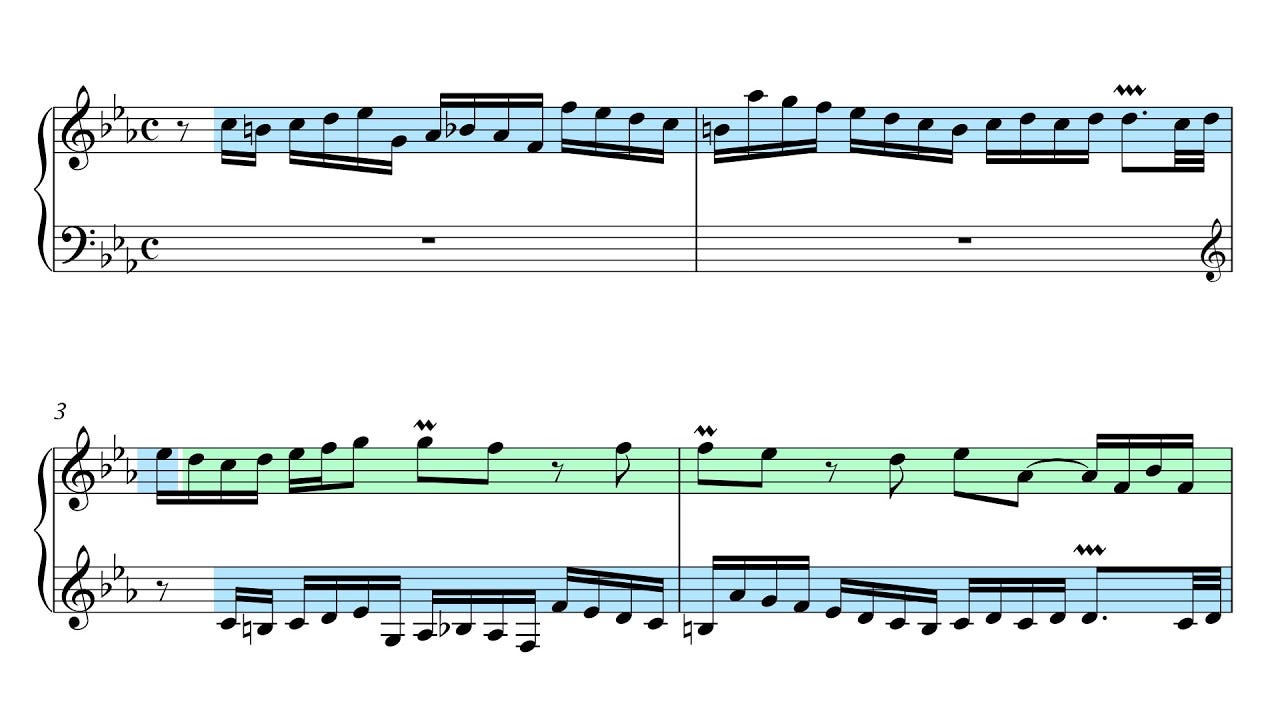
Counting provides a scaffolding on which to build the music. Over time, it seems like the music gets into my fingers and ears, demanding less reliance on the counting. But it’s not unusual to keep mentally counting out trickier passages, or to bring the audible counting back to tighten a piece.
I rely on something remarkably similar in my formal meditation practice.
Noting
Mindful noting involves paying close attention to specific perceptions for a few seconds at a time. To note something means to notice it clearly and then focus on it intently and gently — for a few seconds, or until it comes to an end.
There are two distinct parts to this. First, there’s an initial noticing: trying to be very clear about what you’re observing, taking a moment to be as precise as possible about where you’re about to spend the next few seconds. Second, there’s a period of allowing attention to rest on what you’ve noticed — without evaluating it, without getting caught up in its meaning. Just this one aspect of experience, as it is, for a few seconds.
With practice, the first phase takes less and less time, leaving more room for that relaxed observation.
And we can get better at the initial noticing by working with labels.
Labeling
Noting strengthens focus. Labeling supports noting in a way very similar to how counting supports playing music. To label means to think or say a word that describes what you’re noting. For breath awareness, common labels are simply IN and OUT, or RISING and FALLING. The technique I practice and teach was developed by Shinzen Young. His basic labels — SEE, HEAR, FEEL, IN, OUT, REST, FLOW, GONE — are specific enough to make clear distinctions among complex sensory experiences while being general enough to work in almost any situation.
Speaking labels aloud is a powerful way to build concentration. There’s something about the tangible presence of spoken words that keeps you from drifting too far from what you’re attempting to observe. I use spoken labels when I’m walking, running, or feeling particularly scattered. If speaking aloud isn’t practical, mouthing the words works just as well. Either way, a low, gentle, matter-of-fact tone — spoken or mental — helps settle you into a deeper state of focus.
The pacing matters too. Aim for four to ten seconds between each label. This lets you soak in and savor each experience. It also establishes a rhythm — the same way a steady count anchors a musical phrase — so you notice right away when your mind has wandered off.
Practice makes imperfect more livable
Our minds wander. This is a significant part of what we’re becoming more familiar with over time. Given free rein, attention slips back into its familiar thinking grooves, often without our noticing for several minutes. Breaking practice into smaller segments gives awareness less room to drift — every few seconds, we reestablish the connection with direct experience, the same way a musician keeps returning to the count.
You can miss something. You can be behind in your noting, picking up a sensory experience just as it’s ending. None of this is a problem. Realizing you missed something is actually a sign that your precision is growing. And you can always shift from spoken labels to mental ones to no labels at all, depending on how concentrated you feel. The scaffolding is there when you need it and can be set aside when you don’t.
Even after two decades of practice, I still struggle to focus on any single perception for more than a few seconds. What keeps the practice rich and sustainable is the ability to combine individual moments — sights, sounds, bodily sensations — into extended practice blocks, much like individual notes combine into a larger piece.
Being able to meditate isn’t magic; it’s the result of a lot of practice. However, just as playing the melodies composed by long-dead musicians can feel like magic at times, the experience of meditation can be similarly enchanting.
Not everyone will want to learn an instrument, just as not everyone will want to strengthen their awareness of their senses, thoughts, and feelings. But anyone curious and willing to exercise their attention consistently can discover how much more alive ordinary moments can feel.
If this is something you’d like to explore, I can help.
